
The Impact of Images on a Young Mind

“I would study every single frame of the artwork of a man whose name I did not know at the time was Alex Raymond”

When I was a wee-little lad, back in the early 1980s, there was a movie HBO played almost every afternoon and every night, every summer, seemingly all summer long.  The film’s soundtrack featured music by, as I would later learn, a band called Queen. . . a rocking, constantly thumping and completely action-inspiring collection of tunes accompanying a movie known the neighborhood over as Flash Gordon.  Little did I know at so young an age that the film was actually being enjoyed the world over, by countless fans of all ages made hungry for more fantasy sci-fi thanks to Star Wars.

The movie itself was a great watch for a youngster. . . full of action and dramatic conflict and strange creatures and races and even men with hawk wings!  The ages-old story didn’t hurt the film’s popularity either: that classic struggle and triumph of good over evil.  It was fairly clear-cut, but it was also my first taste of conflict on one side of the equation. . . why were the Arboreans acting hostile toward the Hawkmen and vice-versa?  Weren’t they both “good guys” and fighting the same fight?  At the age of 6, I had never seen anything like that before.  I remember being not so much confused as hurt by it, like when friends or parents argue.  Looking back on that now, it’s how I know I was compelled by the story, because I was reacting to the dynamics of fictional conflict.

But as much as I enjoyed the movie, I didn’t have to fast-forward my VHS taped-from-HBO cassette to get to my favorite part.  All I had to do to reach that point was to merely hit PLAY.  Over and over and over again, I would watch Ming the Merciless wreak havoc on earth with his array of “natural disasters” from the control panel in front of him, and I would stress with awe-inspired abandon as General Klytus cackled with glee.  And then the drum beat would start up with its steady, relentless pounding, and the bass-line would kick in to match it, and then. . . oh sweet jeebus!

With every beat of the drums and every nuance of the powerful guitar, I would be bombarded with a steady flow of the most gorgeous comic book imagery I still have ever seen.  And beyond the events of the movie, which I’ve seen a hundred times in my lifetime, I had no context for these images. . . and therein lay the beauty!  An angry general pointing down a vast hallway, Flash pointing a pistol toward the reader, two swords clashing, a tidal wave washing over Flash’s body (so frail and flimsy in the wave despite all his strength), beautiful girls in beautiful gowns and dresses, the faces of Flash and Dale with eyes closed and a caption reading “. . .and knew that real death could not be far off”, hawkmen swooping overhead in organized formation, Flash standing atop a cliff with his cape fluttering out behind him as he overlooked a vast crowd of people in the canyon below, rockets rockets and more rockets, mad scientists mixing devious chemicals in funny-shaped flasks, massive cities towering ever upward with their future-gothic spires. . . and all while someone I did not know was named Freddy Mercury sang out rock-n-roll power followed by softly crooning about the courage of “just a man.”  Pardon my french, but it was goddamned magnificent!

Screen Shot 2017-09-22 at 9.02.44 PM

I wore that old VHS tape out.  Not just from constant screenings of the movie, but from watching, re-winding and re-watching that opening title sequence a thousand times or more.

My main point is the utter lack of context.  The images alone, flashing by (pardon the pun) at such a rate that the blink of an eye would cost the viewer half a dozen drawings or more, was enough to instill in me such an overwhelming sense of adventure and story-telling that I would eventually resort to pressing pause at the beginning and then moving through the sequence frame-by-frame.  I would study every single frame of the artwork of a man whose name I did not know at the time was Alex Raymond.

In adulthood, I have acquired a few volumes of the Raymond Flash Gordon Sunday comics serial, but while reading through them (as I occasionally do), I cannot shake the feeling that it somehow just isn’t the same. . . that it somehow just isn’t as good as what my childhood imagination was conjuring with the images as taken out of context.

And this, to me, is one of the main reasons and inspirations for writing.  You get the chance to tell your story.  You get to pull the imagery from your own mind, the situations you’ve conjured up and built piece by piece from various bits of inspiration all around you, and form it into something you want to make.

I’m not claiming that my writing is better than that of Alex Raymond, nor that the tale of my characters is more compelling than that of Flash and Dale and Zarkov and Ming.  Not by a long-shot.  But what I am saying is that I get to create, every single day if I so desire, worlds and conflicts and armies and characters that are my very own, inspired by as many or as few things as I have ever dared to love or hate or dream, and that’s a pretty powerful feeling to be able to pluck for absolutely free.  Seriously, can you think of any hobby with as low a start-up cost as writing. . . except maybe the hobbies of standing or sitting?

Anyway. . . cheers to Alex Raymond, cheers to Flash Gordon. . . and cheer’s to Queen!
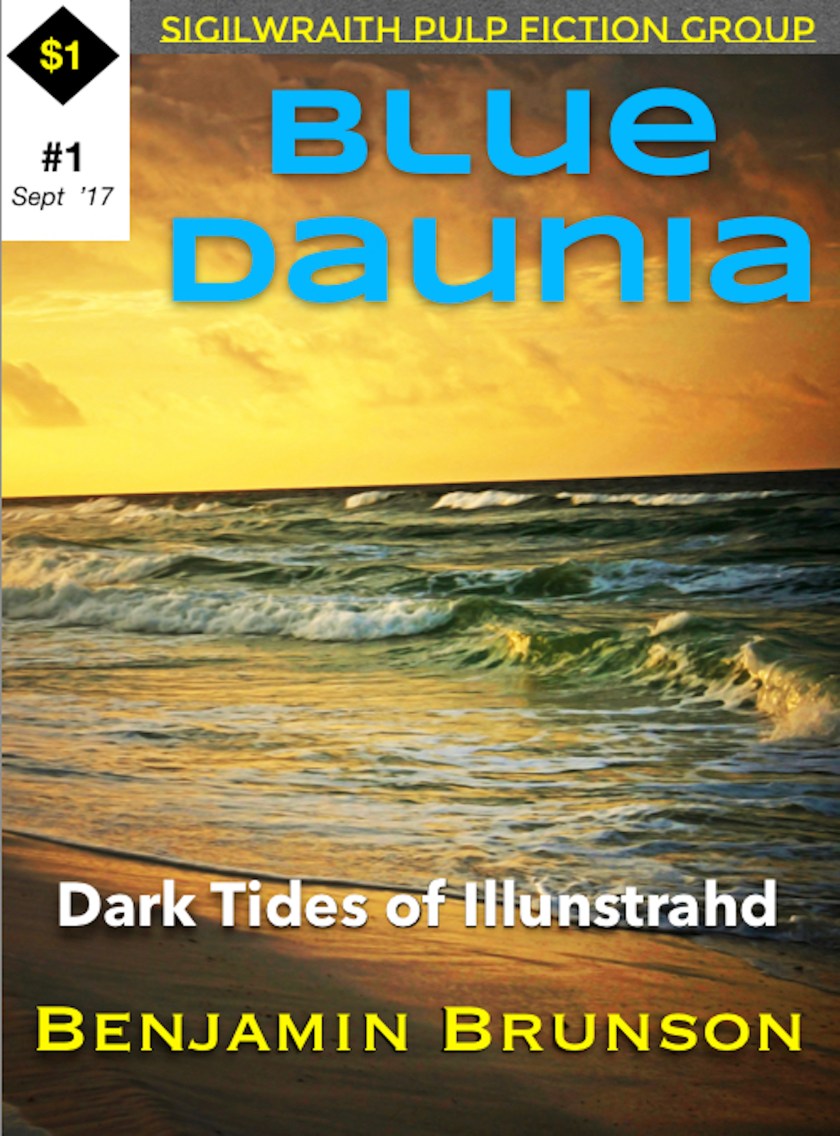
New Covers to Pay Homage to Series’ Roots

I wanted to update the covers of the Blue Daunia series. . . something to reflect my love for the comic books of the 1980s (a huge influence on the series) as well as pay homage to the series’ roots in the pulp fiction genre.  So, moving forward. . . for now, anyway. . . the covers will look like this:

Screen Shot 2017-09-21 at 12.51.47 PM

A minor change, really. . . just added that corner price/issue designation and upper brand designation banner which is a total ripoff of the Marvel comics from the early 80s.  I dig it, though.  Others may disagree, and if you do, please do drop a comment and let me know.  As for now, however, I’m really into this aesthetic, as the whole point of the series was for me to have a comic book in text form (which is essentially what pulp fiction and the “dime novels” were).

And speaking of the series, just a friendly reminder. . . the first issue is still FREE on the Kindle store from now through the end of tomorrow (9/22/17).

Cheers!

MCU and the Changing World of the Comic “Book”

Ahhh, the Marvel Cinematic Universe….  You’ve changed something in your intros, haven’t  you?  But is the change a good or bad one?

My friends and I first noticed it while watching Guardians of the Galaxy Vol. 2.  We saw it again at the beginning of Spider-Man: Homecoming.  Prior to this, the marvelous movies of the Marvel Cinematic Universe had used actual comic book art during the “Marvel Studios” opening logo splash.  To kick off these two new films though, we got slightly painted-over photograph stills of the various actors in-character in various action poses, probably nicked straight from the frames of the films themselves.  Both styles performed the same visual job:  a slew of comic book characters from the Marvel universe duking it out against villains, and the sound and “look” of pages being flipped through… all to indicate that we are about to enter into that larger-than-life realm.

“I’m just not sure I like that,” said a friend of mine as we left the theater from the screening of Guardians.  “No, I’m sure I don’t like that as well as the actual comic book art,” said the same friend after Homecoming.  I knew what he was getting at.  He was lamenting the iconic imagery he had grown up with.  To an extent, I agree with him.  To a larger degree, however, I think I get Marvel’s point.

I grew up in an era when comic books were 75 cents, and could be purchased at any gas station, drug store, grocery store or corner convenience store.  I’m sure comic book stores existed back then, perhaps in larger towns, but not in SmallTown U.S.A.  My father scoffed at the 75 cent, 32-page format.  He often recounted to me the comic books of his youth: a nickel for an issue as thick as a magazine and a dime for something along the lines of the thickness of a composition notebook.  Despite the astronomical price of 75 cents, though, I remember stopping at a gas station during an 8-hour drive to a vacation destination, my parents realizing I was bored with the one or two toys I had kept loose for the drive, and loading me up with half a dozen comics for less than five bucks.  The things were just everywhere.  You couldn’t throw a rock without hitting a store that sold a revolving display rack’s worth of comic books.

Fast-forward 30 years, to present-day Earth.  If you want a comic book today, you either have to sign up for a digital subscription, go into a Books-a-Million or Barnes & Nobles, or venture into a specialty “Comics” or “Comics & Cards” store.  Not only that, but you had also better be prepared to spend $3.95 to $4.95 for a single, slim-as-they-ever-were issue, if not moreso for a special edition with an exclusive gatefold cover.

And every place I go which might feature a comics conversation, the conversations are always about the older stuff, from years ago, either on its own or as it relates to the modern movies and their storylines (or conflict with).  Rarely, if ever (and now that I think of it, honestly possibly never) do I hear a conversation about the new issues or new storylines, whatever they may be… I’m not even able to tell ya what they are!  For me, personally, the true notion of the comic book as well as the true notion of buying a current issue… that all ended in the 90s, well before RDJ donned the Iron Man armor or Chris Evans lit up as the Human Torch (checking for old-school MCU fans here).  And from the aforementioned evidence stemming from conversations, I’m willing to bet that the same holds true for countless others around the world.

I think Marvel knows this, too.  In fact, I think that’s what’s happening with the opening “Marvel Studios” splash at the beginning of the newer MCU movies.  You see, to me, comic book superheroes (which are largely an American invention) represent a sort of American mythology, if there ever was such a thing.  We needed these heroes back in the day, perhaps to help us mentally deal with the scares of WWII, perhaps to steer us more sanely through the Great Depression… and we need them more than ever now (I’m not about to throw up a list of political or world problems facing us today, that’s for a different type of blogger).  But no one wants to go out and spend 5+ bucks on a single 32-or-less page issue.  If we want the older stuff, we can still grab a graphic novel compilation for $10-20… it’s there if we need it.  But if we want the newer stuff, WE GO TO THE MOVIES.

Seriously, that’s what we do now.  Is that a bad thing?  A ding for the industry?  I say no.  And then I say “which industry?”  See, I think Marvel is doing just fine, and they’re doing this level of “fine” with their movies… the illustrious MCU.  Maybe comic books are in trouble… maybe they’re not (I really can’t say, other than the aforementioned conversations), but the American mythological icon which is The Comic Book Character… well, that’s alive and kicking much ass on silver screens the world over!  They’re in the toy aisles of every major department store.  They turn up in Happy Meals and Halloween costume stores.  They dominate notebook covers and computer wallpapers and sell out RedBox copies and cereal boxes everywhere.  The modern day comic book superhero is doing just fine.

But that’s the thing.  Putting everything together… the overwhelming slant of the conversations, the way books have shot sky-high in cost and aren’t on every corner store and may never be again, the dominant strength of the movie-machine juggernauts and the merchandising based largely on the movie images rather than a drawing…. do the math, because I assure you, Marvel has.

Here’s the gist of what I’m getting at:  The cinematic universe IS the new face of the comic book… the books had their chance, and they had a damn good run for maaaany a decade, but the torch has been passed now.  It simply has.  Like it or not (and I personally do like it, and think it would take an overly-sentimental curmudgeon to not [for reasons as simple and un-weighty as “I just don’t like it and I’m gonna fold my arms and huff about it just because, so there”]).  I think Marvel knows this… I think they are well aware of this passing of the torch, and I think they’re silently even acknowledging it… and I firmly believe this is why the new opening logo splash for the MCU depicts lightly painted-over live-action stills rather than comic-artist renditions.  They’re not going to come right out and scream “We successfully killed the old-school comic book!!!”… first of all because someone would get all bent out of shape and “boo-hoo” about a statement like that, but secondly because it’s simply not true.  The movies haven’t killed the comic book… greed and pricing within the industry took care of that all on its own.  The movies simply gave the American Mythological Superhero his new home… “comic books” as a notion and ideology got with the times… and our once-beloved ink-and-print fantasy universe is alive and well on the big screen.  The new opening splash says, very subtly, “this is what the stories are now… movies, not overpriced specialty books.”

I, for one, embrace it.  To hell with paying five bucks for a jumped-up flyer with all the content of a grocery store ad.