Transformations (and Honesty)

Please don’t buy the first two “issues” of Blue Daunia if you haven’t done so already!

It’s an ongoing process, this “art” of writing.  Ongoing not only in the sense of the writing itself, but also in the sense of learning.

Two months ago, I thought I had wanted an ongoing monthly serial.  That’s what the Blue Daunia saga was meant, from the outset of inception, to be.  I regaled myself with the starry notion of reviving the old-school dime novel serials, or even of putting the comic book “continuum” thing into text form.

I did not find the schedule of such a task to be overly rigorous… it was, and is, quite possible to maintain and sustain a monthly serial.  So it’s not really the difficulty of the undertaking (as massive as it is) that has recently caused me to change my mind on the format.

And indeed, the format is changing.  I’ve come to realize how daunting a task the marketing of a monthly serial can be.  Here are a couple of the problems:

A)  The Time In-Between:  I mean this from the point of view of the reader, not the writer.  Where a series is concerned, the modern-day audience is trained to digest installments on a weekly basis, as per television… or by binge-digesting the “season”, as per Netflix or Hulu.  True, when I speak of Blue Daunia I am speaking of the written word rather than an audio-visual production, but the modern take on output and consumption has been formed nonetheless.  Furthering this analogy, as I am equating “issues” of a “serial” with “episodes” of a “series”, I would also equate “novels” of an ongoing “saga” with “sequels” of a “movie”: with a series of novels and movies alike, the reader/viewer is content to wait a year or more between larger, novel- or movie-sized chunks.  It is as expected as the weekly interval of episodes of a series.  (This having been said, I will not be making my potential readers wait even that long… I plan on publishing a Blue Daunia novel every 6 months or so, not every year or two).

B)  The Pricing:  I pose a question to those who may be reading this:  When you are seeking out new reading material, would you rather discover a series of novels that piques your interest and pay $4 (give or take) for a novel-sized volume and realize you only missed out on one or two others that  you would have to invest in…. OR… Would you rather discover a serial that piques your interest and realize that, while the current issue is only 99 cents, you’ve already missed 22 issues and would have to invest 22 bucks to catch yourself up, and then realize that it will have to wait a month between each portion?  Or, to put it another way:  if, three years from now, a friend of yours talked up an excellent serial they’ve been reading as something you should really check out, how would you feel when you discover that, having been three years, there are 36 one-dollar issues you would have to invest in just to have to read 720,000 words (roughly 3,600 pages) just to catch up to where your friend is?  The marketing and price-to-volume logistics are troublesome, to say the least.

So, as much as I would love for you to do so, I’m here and now asking you not to invest in the first two “issues” of the Blue Daunia saga available on the Kindle store.  As much as I would love your support and your dollars, I’m going to be honest… as soon as the third chunk of what has turned out to be a three-part story arc is complete (later this month, October 2017), I’m going to release all three parts as the proper First Novel of the Series of Novels it really should have been all along.  For the several dozens who have already invested in the first two issues, I am still going to publish the tail-end as “Issue #3”, as I feel it is only right to do so, rather than to make these loyalists essentially re-purchase the first two issues all over again, just for the sake of being able to read the conclusion of the first story-arc.  But for everyone else, you can (if I may so humbly request you do) pick up the first NOVEL of the Blue Daunia saga, which will be known as Volume One.

From that point on, the series will be handled in novel format, like Fleming’s James Bond or Rowling’s Harry Potter.  The reasons for doing so, much like Problems A and B above, are two-fold:

A)  I’ve jammed myself up with Issue #3 in terms of the length and pacing.  I’ve spent the first two issues building up slowly to the action, and both of the first issues were 20,000+ words.  But now that it’s all set up, the action of the 3rd issue, if so published, would be so lightning-fast compared to the first two as to seem alien to the reader, not only in terms of pacing but also in terms of page-count:  you see, I’ve not much more to say to finish the first tale other than another 10,000 words or less, half or less the length of the first two issues… and could therefore not justify charging the same price (which I will have to do anyway, sadly, as 99 cents is as cheap as Amazon will allow a Kindle book to be).

B)  I won’t feel so confined by a set monthly word-count, and can allow future novels in the series to breathe a bit more, develop at a more natural pace, than trying to time everything out in a monthly 20k-word allotment.  I can develop the characters more thoroughly… add subplots whereas the current telling of the tale focuses on following one specific set of people along one path towards a unified goal.  I can build the world more strongly, vibrantly and dynamically, adding politics and struggles and regimes and rises and falls.  I can even do spin-off novels of certain characters (Redwood and Morlana spring to mind).  And, most importantly to me personally (again being quite honest here), I can explore other much-dreamt-of writing projects in-between, not the least of which is this blog itself (which I have woefully neglected), as well as other non-fantasy novels which have long been brewing in my mind.

To current readers of the series, I apologize for any inconvenience all of this might cause.  As I’ve stated, the 3rd chunk will still be made available separately, so that you don’t have to re-purchase what you’ve already bought by buying the first novel.  But yes, from now on, Blue Daunia will be a series of novels rather than a monthly “comic book in text form”.

Anyways… Cheers!  And Happy Reading and Writing!

The Impact of Images on a Young Mind

“I would study every single frame of the artwork of a man whose name I did not know at the time was Alex Raymond”

When I was a wee-little lad, back in the early 1980s, there was a movie HBO played almost every afternoon and every night, every summer, seemingly all summer long.  The film’s soundtrack featured music by, as I would later learn, a band called Queen. . . a rocking, constantly thumping and completely action-inspiring collection of tunes accompanying a movie known the neighborhood over as Flash Gordon.  Little did I know at so young an age that the film was actually being enjoyed the world over, by countless fans of all ages made hungry for more fantasy sci-fi thanks to Star Wars.

The movie itself was a great watch for a youngster. . . full of action and dramatic conflict and strange creatures and races and even men with hawk wings!  The ages-old story didn’t hurt the film’s popularity either: that classic struggle and triumph of good over evil.  It was fairly clear-cut, but it was also my first taste of conflict on one side of the equation. . . why were the Arboreans acting hostile toward the Hawkmen and vice-versa?  Weren’t they both “good guys” and fighting the same fight?  At the age of 6, I had never seen anything like that before.  I remember being not so much confused as hurt by it, like when friends or parents argue.  Looking back on that now, it’s how I know I was compelled by the story, because I was reacting to the dynamics of fictional conflict.

But as much as I enjoyed the movie, I didn’t have to fast-forward my VHS taped-from-HBO cassette to get to my favorite part.  All I had to do to reach that point was to merely hit PLAY.  Over and over and over again, I would watch Ming the Merciless wreak havoc on earth with his array of “natural disasters” from the control panel in front of him, and I would stress with awe-inspired abandon as General Klytus cackled with glee.  And then the drum beat would start up with its steady, relentless pounding, and the bass-line would kick in to match it, and then. . . oh sweet jeebus!

With every beat of the drums and every nuance of the powerful guitar, I would be bombarded with a steady flow of the most gorgeous comic book imagery I still have ever seen.  And beyond the events of the movie, which I’ve seen a hundred times in my lifetime, I had no context for these images. . . and therein lay the beauty!  An angry general pointing down a vast hallway, Flash pointing a pistol toward the reader, two swords clashing, a tidal wave washing over Flash’s body (so frail and flimsy in the wave despite all his strength), beautiful girls in beautiful gowns and dresses, the faces of Flash and Dale with eyes closed and a caption reading “. . .and knew that real death could not be far off”, hawkmen swooping overhead in organized formation, Flash standing atop a cliff with his cape fluttering out behind him as he overlooked a vast crowd of people in the canyon below, rockets rockets and more rockets, mad scientists mixing devious chemicals in funny-shaped flasks, massive cities towering ever upward with their future-gothic spires. . . and all while someone I did not know was named Freddy Mercury sang out rock-n-roll power followed by softly crooning about the courage of “just a man.”  Pardon my french, but it was goddamned magnificent!

Screen Shot 2017-09-22 at 9.02.44 PM

I wore that old VHS tape out.  Not just from constant screenings of the movie, but from watching, re-winding and re-watching that opening title sequence a thousand times or more.

My main point is the utter lack of context.  The images alone, flashing by (pardon the pun) at such a rate that the blink of an eye would cost the viewer half a dozen drawings or more, was enough to instill in me such an overwhelming sense of adventure and story-telling that I would eventually resort to pressing pause at the beginning and then moving through the sequence frame-by-frame.  I would study every single frame of the artwork of a man whose name I did not know at the time was Alex Raymond.

In adulthood, I have acquired a few volumes of the Raymond Flash Gordon Sunday comics serial, but while reading through them (as I occasionally do), I cannot shake the feeling that it somehow just isn’t the same. . . that it somehow just isn’t as good as what my childhood imagination was conjuring with the images as taken out of context.

And this, to me, is one of the main reasons and inspirations for writing.  You get the chance to tell your story.  You get to pull the imagery from your own mind, the situations you’ve conjured up and built piece by piece from various bits of inspiration all around you, and form it into something you want to make.

I’m not claiming that my writing is better than that of Alex Raymond, nor that the tale of my characters is more compelling than that of Flash and Dale and Zarkov and Ming.  Not by a long-shot.  But what I am saying is that I get to create, every single day if I so desire, worlds and conflicts and armies and characters that are my very own, inspired by as many or as few things as I have ever dared to love or hate or dream, and that’s a pretty powerful feeling to be able to pluck for absolutely free.  Seriously, can you think of any hobby with as low a start-up cost as writing. . . except maybe the hobbies of standing or sitting?

Anyway. . . cheers to Alex Raymond, cheers to Flash Gordon. . . and cheer’s to Queen!

New Covers to Pay Homage to Series’ Roots

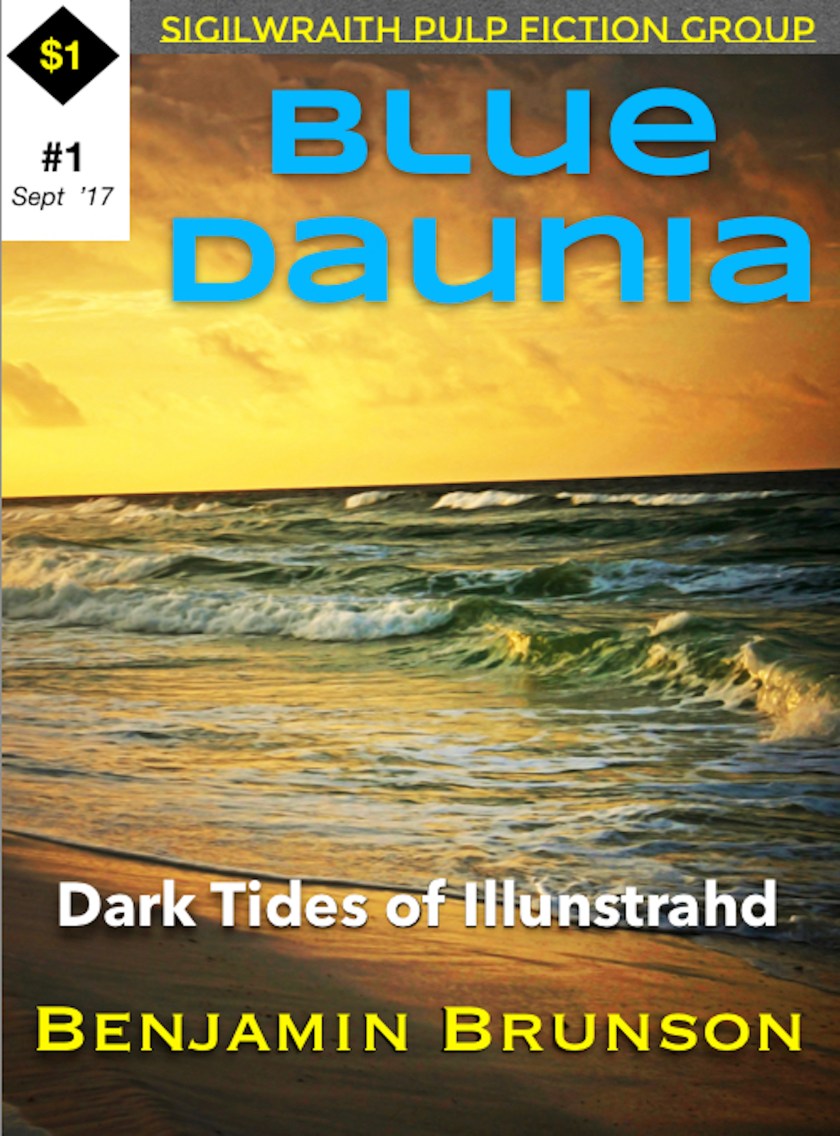
I wanted to update the covers of the Blue Daunia series. . . something to reflect my love for the comic books of the 1980s (a huge influence on the series) as well as pay homage to the series’ roots in the pulp fiction genre.  So, moving forward. . . for now, anyway. . . the covers will look like this:

Screen Shot 2017-09-21 at 12.51.47 PM

A minor change, really. . . just added that corner price/issue designation and upper brand designation banner which is a total ripoff of the Marvel comics from the early 80s.  I dig it, though.  Others may disagree, and if you do, please do drop a comment and let me know.  As for now, however, I’m really into this aesthetic, as the whole point of the series was for me to have a comic book in text form (which is essentially what pulp fiction and the “dime novels” were).

And speaking of the series, just a friendly reminder. . . the first issue is still FREE on the Kindle store from now through the end of tomorrow (9/22/17).

Cheers!

Blue Daunia Issue #2 Now in Paperback

Well, the paperback is now available.  This leg of the story, I guess you might say Act II of a three-act arc, was a labor of love, and while the old adage maintains that you’re not supposed to favor one of your own children over another, I must say, I absolutely adore this issue.  That’s a difficult thing for me to say, too, because despite marketing’s main goal and purpose being to play up the hype and appeal of your product, I’m a bit modest really when it comes to my own work.  But I will allow myself the indulgence of telling you this, with all sincerity:  If you pick up these first two issues (the first one currently being free for two more days on the Kindle store), you might find the first one slow-building, but I firmly believe you will not be disappointed by the end of the second issue.  I really do feel that strongly about it.  I’ve often heard and read the advice “write the book you would like to read”. . . well, Issue #2 is that book.  I’m serious when I say I don’t like to brag, but it’s just such a quick-moving, fun 122-page read!

Speaking of the FREE first issue, here’s the link to that. . . good through the 22nd.  And Here’s the link to the second issue in paperback, as well as the in the Kindle store.

And, just because I wanted a longer post, the following is the introduction from Blue Daunia Issue #2:  The Sinister Sleep of Shevara:

INTRODUCTION

For Christmas of 1992, I got my first word-processor.  I was 17 at the time, and had big plans for that thing, which is fitting, because it was a big thing, literally.  I want to say it was a Smith Corona, but whatever it was, the thing was the size of a small suitcase.  It had a built-in printer, a thin green monochrome calculator-style LCD screen, and a 3.5” floppy drive.  That last one really excited me, you see… because at last I could rack up volumes of my upcoming masterpieces and save them all on such tiny little storage media.

In the weeks leading up to Christmas that year, I could barely contain my excitement, because I already knew I would be getting this thing, and I had worlds to create!  I was very much a fan of comic books back then, and even moreso what they represented to me:  vast universes in which a creative, resourceful individual could create characters both mundane and mystical, and in which the stories of these characters and their interactions with each-other could be told in a continuous series.  (Incidentally, this is the same reason I love Dungeons & Dragons, but I digress).

More than anything else in the world, at that moment, I wanted my own comic book universe, which I could mold and shape and tinker with to my heart’s desire.  But here’s the thing… I cannot, CANNOT, draw.  My stick figures sometimes get mistaken for ampersands, if that tells you anything about my artistic abilities.  So what was I to do?  Well, I could write.  Everyone seemed to say so.  Sometimes, every now and then, they still do!  So that was my angle… I would do a comic book universe in text form, and store every story on those tiny little floppy disks, because surely, those would never, ever get lost or fall prey to the hands of time.

So Christmas rolled around, and I got the gigantic word processor, and I cannot for the life of me think of a single blasted thing I wrote on that thing, except maybe a school essay or book report or some-such.  Oh, and the screen could be tilted upward at different angles to better catch the light, because there was no contrast control… but whenever I would tilt the screen forward, it would ease itself on back down again.  So I did what I had to do:  I got the rifle-like weapon from JetFire of Transformers toy fame and wedged that behind the screen when I lifted it.  That sure learnt it!

So, what am I trying to get at, amidst all this rambling?  No, I’m actually asking you, because I honestly don’t remember.  There was a point at some… point, I’m sure of it.

Oh!  Manufactured universes.  Fast-forward 25 years, and I’ve finally made myself one!  And here it is!

Azaria
An exotic world not unlike our own, but entirely beholden to the mythology, legends, and pantheon forged by the almighty sea. With a myriad of cultures that run the gamut from backwater to highly advanced, Azaria is a world whose sole provider of technology is as secretive as it is powerful, at times competing with the oceanic pantheon itself for ideological supremacy. But there is something else beneath the shimmering surface, deep within the Hadopelagic Zone… waters so deep that all cultures unite in referring to them as “the Blue Hell”… something darkly intangible and unspoken. Could there be a third force, ancient beyond all recorded knowledge, vying for supremacy?

Daunia Bluehaven
In her ongoing quest to investigate the disappearance of the brother she barely knew, her adventures aboard her father’s final ship design would lead her crew all across the coastlands of the world of Azaria.

Set sail with the crew of the Blue Daunia on their harrowing oceanic journeys. The swashbuckling monthly serial continues here. Join Daunia and her crew as they traverse a world of towering cliffs and arctic tundras, dense tropical forests, sweeping mountainscapes, cavernous subterranean depths, marble palaces, gothic spires, dusty libraries and raucous drunken inns. In the life of a freelancer, you never know where your next job might take you, or what odds you might face to get it done.

In this second installment, the crew continue their stay in the port town of Illunstrahd, though far from the recreational stint they hoped it would be. Along the trail to solve a few grisly murders, death seems to haunt their every step. Exhausted and uncertain of their fate, they come at last to the ancient temple of the demi-goddess Shevara.

Blue Daunia Issue #2, and Free Issue #1!

After a three day delay, Issue #2 of the Blue Daunia series is finally available on Kindle, and will be available in paperback on Amazon and CreateSpace very soon.

Screen Shot 2017-09-18 at 9.20.25 PM

I have to admit, I’m proud of this powerful cover image, courtesy of Donna Chiofolo Photography.  There’s just something about a lone seagull amidst stormy clouds that really captures the feeling of hopelessness in what I consider a gripping last chapter in this issue, if I do say so myself (which I certainly seem to do).

Also, from now until September 22 (2017), the inaugural issue of the series can be had on the Kindle store for FREE!  It’s hard to beat free reads.

I would like to take a moment to apologize for my absence of late.  I think it’s been a week or more since I’ve posted anything to my blogsite.  This is not from any sort of disinterest in my followers or potential future followers. . . on the contrary, I’ve had a heck of a crunch-time this past week trying to make the deadline and polish a quality product on Issue #2.  They say honesty is the best policy, and that’s the honest truth. . . a deadline paired with a day job is not a fun combination, especially when you allow yourself to get behind in that deadline goal.  So, my many apologies, and Happy Reading & Writing, all!

A Funny Thing Happened On the Way to the Word Count Goal

A thousand words of the saga per day.  That’s the personal, ongoing goal I’ve set for myself in writing the Blue Daunia series.  I usually hit it.  Hell, I actually usually exceed it!  Rare indeed are the days I fail to meet my goal.

I thought today might be one of those rare days.  Spoiler alert:  it wasn’t; I made it.  Exceeded it, actually.  But it was certainly no thanks to my good friend James.

A bit of background:  James is very good when it comes to the technical aspects of computers.  He knows his networking, is fairly proficient in making machines do what he wants them to do, and has even worked for a fairly major networking specialist company.

So anyway, I headed to a famous coffee shop around 6pm, ready to “clock in” and get to work toward my 1,000 word goal.  James would be joining me shortly, as he often does, with his laptop and his big ol’ book on some sort of programming language he’s trying to learn. . . phpBB+ Omega Beta or something (is that a thing?).  I don’t mind his company during my “work” nights, as he’s one of my longest-term friends and a decent fella to bounce ideas off of, and usually keeps to his own studies when I’m trying to lay the hammer down on some text.

At about 6:30, I’ve already gotten 200 words pounded out on my AlphaSmart Neo2 when James saunters in, his trusty laptop bag on his shoulder.  He plunks it down on the table and hits the line to order his drink (I’ve already settled in with my iced black tea with mango).

At 220 words, James is back at the table, pulling the PhpBbPbPBp book and the laptop from the bag.  He goes to hook the power brick to the laptop and plug it into an outlet, when he realizes that the back left part of the black plastic chassis is cracked, and although this is where the brick attaches to the computer, that particular connection still feels firm.  Nonetheless, the little orange charging light won’t light up, and on the screen the little lightning bolt is failing to appear over the tiny image of a battery.

I’m a decently resourceful fellow, so I pinch the chassis firmly together and offer a “now try it.”  No dice.  Not charging.  “Let’s try a different outlet”. . . or two, or hey, five.  It’s a no-go.  This thing has just had it, with the indicator suggesting that there is only an hour and a half of battery life remaining before shutdown (and we all know how that goes).

James whips out his smartphone and quickly checks his checking and savings account levels.  “Son of a bitch,” he says.  “Oh well. . . feel like riding around with me to a few places and shopping for a laptop?”  He has determined that he can afford roughly $400 toward a new one, which he was going to get on Black Friday of this year anyway, as his current machine is over 3 years old (a veritable dinosaur in computer years).

“Sure,” I relent.  So much for my word goal for the day.

We hit Best Buy first.  He likes an Asus and a Dell he sees there, finding the Lenovos to be either too cheap or far too expensive, with no middle ground in evidence.  James is a bit picky when it comes to his laptops, as we all should be, so he wants to shop around.

We hit the interstate for a few miles and head for the area’s ritziest Wal-Mart.  I can practically feel my word goal vaporizing before my very eyes.  If you happen to find yourself at the Wal-Mart at the rich end of Montgomery, Alabama, and you are there for the purpose of searching for a laptop computer, I pray to God you have your heart set on an HP, because that’s exactly what you’re going to find there.  HP, HP, and other HPs.  There was one which seem to fit the bill, but it’s only 7:53, and there’s a Target right down the road.

Oh Target, you silly little creature.  For all your mouses (mice?) and memory cards and gig sticks and styluses and carry cases and screen protectors, you’ve only got two laptops for sale, haven’t you?  The one on clearance with the crushed and open box, and the one you’d have to skip two mortgage payments to purchase.  James reluctantly picks one, though:  the Dell we saw at Best Buy, that very first place we went to. . . the place that was right across the street from the famous coffeehouse.  8:27pm at this point, and Best Buy closes at 9.

Word goal?  What word goal?

We hit Best Buy for the second time at 8:42. . . just enough time for absolutely no one to offer to help us.  I’m going to jump ahead ten minutes here, because it basically amounts to us having to flag someone down with flare guns and whistles.  At 8:59, we’re out the door and heading back across the street.  That particular location of the coffeehouse closes at 10, so that gives us an hour for James to get his new machine set up and running and for me to try to hammer out a few more paragraphs.

Have you ever tried to get some writing done when a clumsy box and scraps of cardboard and twist-ties and plastic bags and pieces of foam of various sizes are bombarding the area within two feet of you?  Try it sometimes!  I humbly invite you to do so.  Or don’t. . . because neither did I!

The new machine is now sitting on the table before us, in all its Dell glory.  The power brick is firmly attached on the PC end.  Time for James to plug it into the outlet.  Nothing.  No orange charging light, no little blue ring around the power button, no magical first-time screen illumination. . . nothing.

It’s at this point that Tevaris, one of our favorite baristas, comes walking over.  “James, man. . . you havin’ any luck with that outlet?”

James:  “No, why?”

Tevaris:  “We think some sort of breaker got tripped.  None of these outlets are workin’.”

James:  “How many of them?”

Tevaris:  “NONE of the front-of-house outlets, man.”

James:  “For how long?”

Tevaris:  “Since this afternoon.”

Alrighty then.  Sometimes you just have to apply palm firmly to forehead, and while I cordially declined to do so, James obliged himself in earnest.

The next part of the plan involved driving BACK over to the ritzy end of town, where the ritzier Target and ritzier Wal-Mart were.  Our destination:  the ritzier famous coffeehouse, this one open until 11pm.  We arrived at 9:30.  James plugged both machines in, and immediately got the orange charging lights on both.  “Damnit” he hissed.

“Had you really rather they were both broken?”  I asked.

“Almost!” he replied.

For the next hour and a half, he fumbled around with setting up his new machine, which he decided he might as well keep, seeing as how he was in need of a new one anyway.  And for the next hour and a half, I hit somewhere in the neighborhood of 1,115 words.

The moral of this little tale:  never count your chickens if you don’t even have an outlet to plug your incubator into. . . or something.  Something about chickens, I’m almost sure of it.

From the Journal Of Dagrith Helgram

First Mate of the Karcifex, June 16th, 1918

I am leaving.  Captain Josiah doesn’t know it yet, but I am leaving his service as well as the Karcifex post-haste.  I aim never to return.  I cannot.  I fear for my very sanity now, as well as for my own physical safety, and I must keep my mind and body whole for the sake of my sweet Adriana.

   Ever since we took into our cargo that most curious crate stenciled with the letters HOGD, which we acquired in Cairo for an unnamed  client in Scotland, the usually auspicious outlook of the crew has taken such a dour turn.  Captain Josiah told us nigh immediately that we were not to ask questions about the crate, nor enter the sequestered chamber of the cargo hold in which it has resided in the bowels of the Karcifex since we launched from Egypt.
   The first sign that all was not right occurred late one evening as we were entering the Straits of Gibraltar, when a foreboding bout of Saint Elmos Fire emanated from the door of that same chamber, effecting no other part of the ship save the door itself.  Ever since then, those whose work takes them close to that door have been struck to the bone with a sense of dull but palpable dread, easing gradually with each passing hour away from the holds.
   Particularly troubling is the case of young Hollingsworth, a humble but cheerful cabin boy in our employ.  He was tasked one night by Josiah to actually enter the chamber to ensure the structural integrity of the crate, following a loud crashing and creaking sound originating, as we all thought, from behind the door.  Upon his return to the deck, the youth reported that no harm had befallen the crate, and that furthermore there was nothing of concern worth noting about the chamber whatsoever.  But there was a melancholy, drained look to the boy’s eyes, and a pallid hue to his skin.  The following two days, he said not a word to anyone, simply carrying out his assigned tasks with a mere nod and obeyance, where before there had always been jest and merriment and inquiries as to our next destination.  It was at the end of this second day that he climbed slowly to the crow’s nest, and flung himself into a crumpled heap upon the deck at the captain’s feet.
   In the following days, members of the crew have reported all manner of ungodly things.  Voices, eerie lights in the peripheral of their vision, fleeting shadows met with brief but substantial chills, and terrible headaches as though something were trying to claw its way out of their skulls from the inside.  Amid these complaints, and the ever-growing sense of dread emanating from the chamber door, our captain remained steadfast in his dismissal of what he referred to as “ridiculous rumors from a crew beset with a school girl’s fears and whimsies.”  Of the fate of young Hollingsworth, however, he uttered not a word since the peculiar and tragic occurence of the ending of a life.
   I may have been inclined to agree with the stalwart captain, had the voices and visions not crept into my own humble observance beginning not three days agone.  And the headaches.  Such horrible ordeals that I dare not try to reimagine.  Nay, I have seen the shadows.  I have felt their dread chill.  I have seen the fleeting lights out of the corner of my eye.  But the voices.  My God, the voices.  I recount them here now from the best of my memory:
   “…never passed on”
   “…something else within their blood”
   “…not unto the burning”
   “…cannot tell the water”
   There is one voice, however, that I shall never forget all the remaining days of my life, though I shall try my utmost to do so.  It was last night, my final night aboard, as we tied the Karcifex to the rigging of this Port of London.  A cold, foreboding shadow crept it’s way up the wall of my cabin, and as I turned toward it, hoping it would dissipate as all the other curious shadows had done prior, it instead made itself manifest and came to stand very close to the edge of my bed.  I could feel its hideous and utter lack of God’s light and graceful warmth, the bone chilling sting of the coldness in its stead.  I sank in horror and a fear-induced state of paralysis as it reached an incorporeal jagged claw of darkness toward my face.  And it uttered one word, and repeated it twice, a word hissed with such malice and hatred that I cried aloud at its utterance.  “Crowley,” it whisper- hissed.  “Crowley.”  And all sense of light and human decency left my very being for a time unknown to me…an eternity it seemed.  And then it was gone.  As soon as the whispy shadow of the fingers curled about my forehead, and the terrible utterance threatened my very sanity, it had all vanished.
  In these weary hours of the trembling dawn I now strike north under cover of the fading veil of stars.  It is a long way from here to Devonshire, to my beloved Adriana.  I know not what, if anything, may follow me now, but I pray to God I see her pretty face again.

–D.J.H.

To Dog

In the early days of the Amazon Kindle, there existed a forum community unlike any other, comprised of readers who marveled at and embraced a new technology. One such forum member called himself “Dog.” He was an older gentlemen, and it saddened us all when he passed away. I drudged up this response to his passing from a file ten years old now and counting.

To dog:

Friend,
The time has flown,
The day gets on
With its gray, clouded empire
Sharply waning toward the dusk.
(The tic-clink winding of a watch
Mingling with the cold and cheerless sky).

Later, tequila finds me
Framing memories of you
With not enough rusted nails
To rust to sleep
In cellars marked with webs
Of darkened silk-like words
That snare the mind in jest
And boundless play.

Dusk is not the end,
Old friend, dreamer
Who endured us all
With a thousand fragment-laughs
And fleeting thoughts like spinning coins
That only patience purchased for a while.

And where does it find you?,
Where leave you now?
Bitter-proud hearts of a family,
Stagnant cells of posts
Fondly recalled in tones of sepia
From time to saddened time
Cannot contain you.

Rest in peace, old dog,
Never rust away
In frames of brittle memory
Nor the graying silence of a day.

Daytona Blues (a Snapshot)

written in 3/4 time signature

With every step he was fighting against the rain, trying his best to hold his hat in place.  It was a fedora.  Ballcaps are overdone and overrated.  He was making his way down Volusia Avenue toward the ocean, as that was his goal, to reach the unburdened roiling of the sea.  It had been a while.

From the corner of his eye, he could see a rail-thin black cat trying its best to walk sideways against the wind, but occasionally giving up ground in order to pounce at something caught by the small river flowing into the gutter.  The oncoming car that burst into the moment sent a small tidal wave, along with the cat, gushing onto the curb at his feet, and in that moment, he didn’t know whether to curse the car or laugh at it all.

Laughter won.  He reached down to pick up the flailing cat as it tried to regain its footing, causing it to writhe all the more against a spontaneous kindness it perceived as a threat or perhaps couldn’t fathom at all.  Whatever the reason, the feline continued its struggle as he placed it, with great effort and much pain from the claws to his hand, into the messenger bag at his side.

“You should at least be a bit drier in there for a while,” he said, barely able to hear his own voice above the wind-whipped downpour.  The only reply was a hiss and the violent rattling of the bag against his hip, which gracefully and intermittently subsided after a moment.  He pressed on toward the beach.  He was close now.  He could tell by the tears that started to caress his cheeks.  A Shoney’s restaurant suddenly appeared in the gray mist to his left.

The tile of the foyer floor looked ancient, or at least from the 1950s: little white rectangles all laid out in parallel and perpendicular angles to each other, and all dirtied and slapdash from the rainy-muddy feet they had had to endure this day.  He thought he could make out a familiar face in the haphazard patterns of the grime.  Eliza?  The bag stirred and rattled lightly at his side, perhaps in protest or approval of the No Doubt song playing faintly in the background.

“Dining alone today, sir?” the hostess asked in a tone that actually seemed genuine in its cheerfulness.

“Solo,” he replied, having to clear his throat and repeat the word more clearly.  “Alone sounds so negative.”

“Oh,” she chirped with a plastic smile.  “Right this way.”

He was lead to a roundabout booth at one of the front corners of the building, and took instant comfort in the way the rain played against the window, now soothing, now thrashing, now calm and rolling and pittering again.  If he counted himself, there were four customers in the place, and none of them appeared to be so young as he, nor as high-strung.  In fact, their calm and unconcerned demeanor was like a slap to his face.

“Afternoon… welcome to Shoney’s!”  The voice startled him, and his start in turn caused the waitress to flinch a bit.  “Start you out with something to drink?”

“Your hair,” he said, nearly whispering.

The waitress almost-defensively put a hand in her wavy auburn locks, shoulder length and a source of unhideable pride for her.  “What about it?”

He stared at her, his eyes dancing from hers and then to her hair and back, sustaining an uncomfortable seconds-long silence.  “I knew someone,” he finally replied, turning his gaze back to the window.

“I’m sure it’s quite a story,” she said.  “Drink?”

“Coffee,” he said.  She nodded her head, and as she began to turn away, he grabbed her elbow with a swiftness that both scared and somehow electrified her.  “Hot,” he said with authority.  “Hot, hot-hot, hot coffee.”  The bag rustled and bumped on the booth cushion beside him, and he wondered if she had even noticed.

“Straight from the pot to the microwave,” she said with a forced smile, and, turning, fled abruptly.

An elderly gentlemen, trying to enjoy a turkey club a couple of tables over, had sensed the awkward tension in the vicinity, and turned not in time to see the terse interaction between server and customer, but a wet young man in the corner booth, hunched over and talking into what appeared to be a decently-sized brown purse.

The rain was beginning to ease up when she returned.  The cup she sat on the table before him was bellowing forth a cloud of steam, a veritable veil forming between them.  “Are you ready to order?”

The Horrors of Writing the Heartbreak of a Child

“I am getting through this issue with plenty of cat videos and Nintendo 3DS sessions”

One of the hardest things I’ve had to do lately. . . I am hesitant to say “ever”. . . is to write the words and third-person glimpses of the thoughts and mind of a young child whose parents have just been murdered.  We’re talking five years old here.  I had no idea just how difficult a task this would be, or how many pauses I would require to dab away tears of my own as I go.  At times I even have to step away.

Sure, I’ve stepped away from my writing before.  Plenty of times.  It’s a bit of a ritual, actually: write until I hit a proverbial wall, then step away to coffee myself (or take a vape or whatever) and walk around a bit until I’ve come up with more to say.  But this marks the first-ever time I have had to walk away for another purpose entirely:  to gather my wits in the wake of a tumult of sheer emotional overload.

What is it about innocence, particularly the innocence of youth, that so firmly pulls at the heartstrings?  The simple answer is “sympathy”. . . but is that it, or is there more to it than that?

Here’s the thing.  It would be easy to gloss over the whole thing.  It would be simple, if this were any other project, to state that a tragedy has happened, the poor child was all broken up by it, boo-hoo, and then five years have passed, or ten or twelve.  But I can’t do that.  This is an ongoing monthly series, and I am in the thick of the narrative which involves other plots and characters as well, so I can’t gloss over it.  I have to be there, with and for this child, as she wakes the next morning, as the police conduct their investigation, as stern and official strangers question her about what she saw and heard and did, as the adult forces around her attempt to find her next of kin and determine where she will live until such time.

And all the while, I have to put myself in this child’s shoes.  I have to muster the manufacture of her responses, verbal and non-verbal alike.  It is a difficult task indeed to create, from thin air. . . to cull into being. . . something so heartbroken and confused and utterly abandoned (even if by force) as this.  And then I still have to make it clear and succinct.  Because the world still demands terse, lean writing.  “Accessible and concise” rules the roost in the world of prose, and I find myself struggling to conform.

The overwhelming urge is to devolve into a Faulknerian stream-of-consciousness style (and I use the word “devolve” with all due respect to Faulkner, not to knock that style as anything “lesser” but merely to illustrate what feels like the expectations of the modern audience for clarity and sharp focus).  It would be far less painful, or at the very least more therapeutic, that way.  And indeed, I have used this style to open Chapter 2 of Issue #1, but it felt warranted then, because someone was unconscious yet still thinking, and it made for a hell of a flashback.

But this time, again, I have no choice but to face the horrors of writing out in painful detail the tribulations of this poor young thing.  Not only have her parents been murdered, but she came face to face with her mother as the life was draining away.  She had to endure the scarring sight of it, and the confusion of her own mother sounding, to her young ears, angry in urging the child to run.

“There was so much blood.  I didn’t want to run, but Mama told me I had to.  I didn’t want her to be mad at me and be so badly hurt, too.”  She began to sob freely as she struggled through her next words:  “I didn’t know why she was yelling at me to leave her.  I don’t know what I did wrong.”

And that’s just one little passage, at one little point in time.  Ugh, I can’t even. . . .

But I’ll plow through it.  It is my job to do so.  I have to go to the darker places in my created world, as well as the light.  I have to plumb the depths of the horrors as well as the light-hearted quips and one-liners.  There has to be stark contrasts from time to time, else the highs will never be truly as high as their potential allows.  It is my personal opinion that if a writer does not explore the darkness of his or her creation, and take the reader down into those depths, the high points and humor will come across as mere bubblegum-pop-glitter.

It seems fitting to me that this exploration starts in earnest, in this particular case, in Issue #2.  Steven Spielberg and George Lucas have often said that the second installment of a storyline should be darker, with greater risks, truer threats and much more to lose.  This does not, however, make the task any easier.  I am getting through this issue not only by sheer force of will, but also with plenty of funny cat videos and Nintendo 3DS sessions.  You have to do something when you step away, after all.

Just know this:  It’s okay to cry when you write.  When it happens, you’ll know you’ve hit a primal truth in some raw, lurking form, and there’s an overwhelming chance that this truth lurks not only within yourself, but within the reader as well.